Personal instruction
Learn a personal meditation technique with an experienced instructor. Instruction is free, and further lessons are available as your practice develops.
MEDITATION / THE INNER JOURNEY
Meditation turns our attention inward. Through an uplifting idea and a steady practice, we learn to move beyond distraction towards peace, awareness and a more expansive sense of who we are.
At Ananda Marga Yoga Center, personal instruction in authentic yogic meditation is offered free of charge.
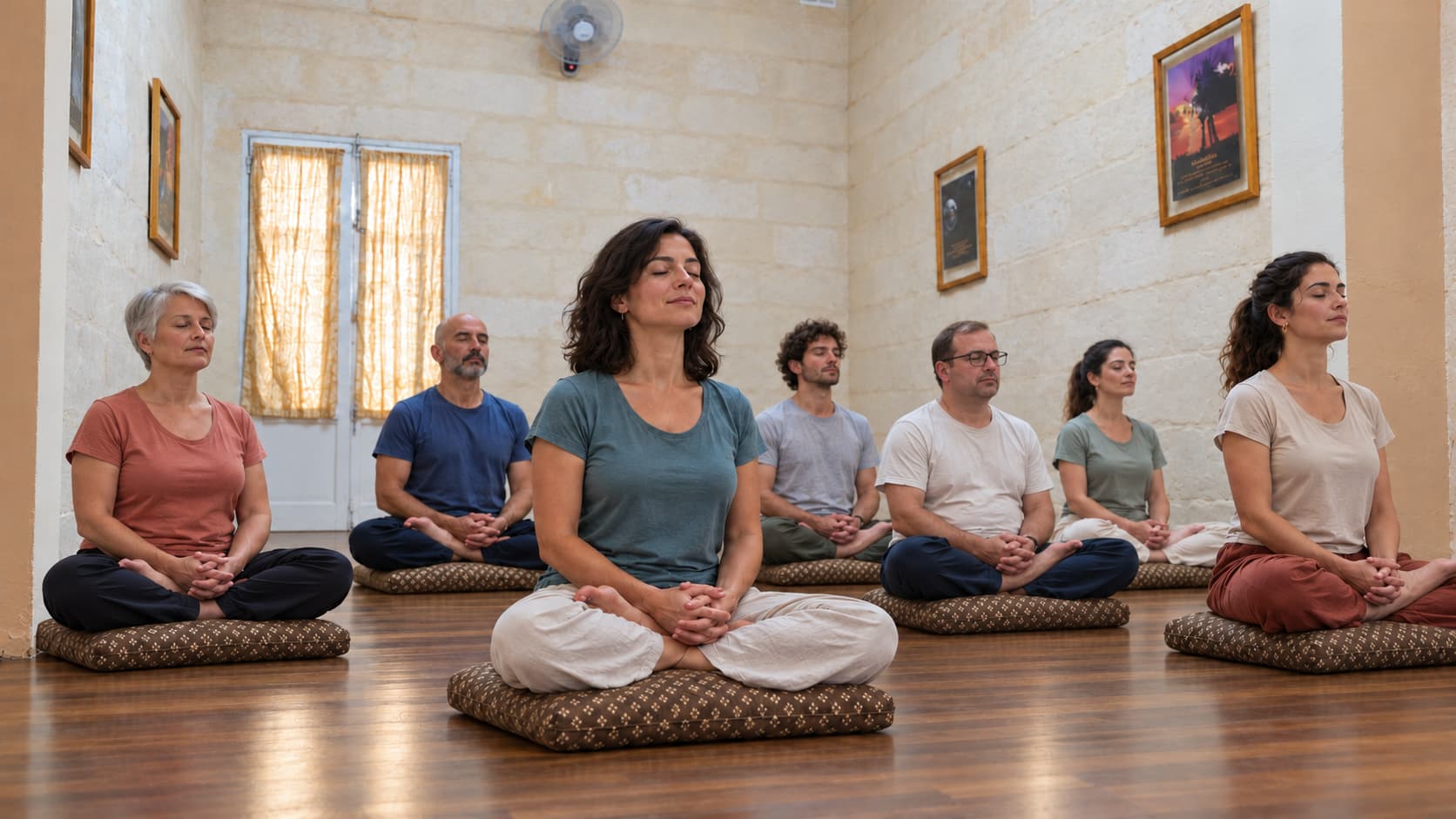
Yogic meditation develops the mental and spiritual aspects of our lives. Ananda Marga’s approach begins with a simple principle: what we give our attention to shapes our mind. We therefore concentrate on a positive, expansive spiritual idea.
Experienced instructors explain how to withdraw attention from outside distractions and bring it within. With regular practice, this can become a source of inner peace, harmony and a stronger capacity for attention and learning.
Relaxation and physical and mental wellbeing are part of the motivation for many people. The spiritual purpose goes further: in Ananda Marga teaching, contemplation of the infinite helps us discover our deepest nature and feel connected with all life.
A calm body, a focused mind and an inspired spirit belong within an active life. The inner journey is accompanied by responsibility, compassion and service to others.
Self-realisation and serviceA PRACTICE THAT GROWS WITH YOU
Learn a personal meditation technique with an experienced instructor. Instruction is free, and further lessons are available as your practice develops.
Join others for collective meditation at the centre. See the published weekly class programme, and contact us for details of Sunday collective meditation.
See the weekly programmeRegular intensive meditation seminars offer opportunities to explore the teachings and devote more time to practice. Ask us about upcoming sessions.
22 QUESTIONS / ROOM TO EXPLORE
These answers introduce the Ananda Marga perspective on meditation, spirituality and everyday practice.
Meditation is more than concentrating on an ordinary object. In this spiritual practice, attention is directed towards the source of awareness within us. Ananda Marga teaches that, as this exploration deepens, we discover consciousness beyond the limitations of our individual identity. This goal is called self-realisation.
Yogic philosophy distinguishes the changing mental and emotional self from our spiritual Self. Our individual mind, closely associated with the body, gives rise to the feeling of being a separate person. The spiritual Self is understood as a reflection of Infinite Consciousness: eternal, unchanging and unlimited. Self-realisation means recognising this deeper nature rather than identifying entirely with the changing ego. The distinction is between relative, changing experience and the enduring spiritual reality that yoga seeks to reveal.
Physical postures, or asanas, are one part of yoga. They support the body and help prepare it for meditation. Yoga also includes a philosophy of life and a system of spiritual development; its goal is union of the individual self with Infinite Consciousness. Meditation is the central practice for the mental and spiritual aspects of that journey, while the wider yoga system supports physical, mental and spiritual growth together. Explore our approach to yoga.
Prayer takes many forms, including requests for help, gratitude, worship and quiet contemplation. The Ananda Marga perspective understands an all-knowing, loving Divine presence as already aware of our needs. It therefore emphasises devotion and a desire for deeper love over attempts to bargain with or appease that presence.
Grateful and contemplative prayer can cultivate devotion. Spiritual meditation takes a non-dualistic approach: its aim is to merge the individual sense of “I” with Infinite Consciousness. The teaching sees this inward practice as the heart of spiritual realisation, even where a tradition’s outward teachings and rituals have become more prominent.
Ananda Marga describes meditation as an intuitional science: a disciplined exploration of inner experience through practice, observation and reflection. Measurements of physiology or brain activity can study external effects, but cannot fully describe what a practitioner feels or realises. The mind itself is the place where the spiritual practice is experienced. In this tradition, Tantra names the systematic approach to developing consciousness and moving towards union with the infinite.
Here, spirituality means the search for Infinite Consciousness and the effort to unite individual awareness with it through meditation. It is distinct from spiritualism, which concerns mediums or communication with the dead. Ananda Marga understands the realisations of great spiritual teachers, including Buddha, Jesus and Krsna, as expressions of a universal inner truth.
Spirituality, in this teaching, encourages inquiry and personal experience. Writers have explored parallels between the accounts of reality found in yoga, Taoism and Buddhism and ideas in modern physics. Such comparisons can inspire reflection, but they are interpretations; quantum theory does not establish Infinite Consciousness as a scientific fact. The spiritual understanding presented here is explored through philosophy and meditation, while scientific questions require their own evidence and methods.
Shrii Shrii Anandamurti describes mysticism as the continuing effort to bridge the finite and the infinite. It is an active search for connection beyond our limited identity. Wonder and awe can also motivate inquiry into the universe, as expressed in Einstein’s appreciation of mystery. In spiritual practice, this becomes an invitation to explore consciousness directly.
The distinction made in Ananda Marga teaching concerns inward realisation and outward belief or ritual. Spirituality centres on a reasoned understanding of Infinite Consciousness, a non-dualistic goal, direct experience through meditation, and a way of life that involves every aspect of our existence.
Religious institutions may emphasise doctrines, ceremonies or a relationship with a separate Divine being. Traditions differ, and many also contain profound mystical practices. Ananda Marga encourages looking beyond dogma and divisions to the spiritual purpose of liberation, universal love and the inner realisation taught by great spiritual guides.
Spiritual meditation concentrates on an expansive idea associated with Infinite Consciousness, such as unlimited love, peace or happiness. The name used for this presence matters less than the awareness that it is within us and all around us. Because our experiences are known through the mind, the practice turns inward to the source of feeling and awareness. Its aim is to move beyond the limits of the individual “I” and towards union with the infinite.
No. Spiritual practice is open to people living family lives as well as to monks and nuns. The tradition points to both kinds of example, including the married teacher Shrii Shrii Anandamurti, monastic figures such as Buddha and Swami Vivekananda, and women such as Teresa of Avila and Anandamayi Ma. Commitment to practice matters more than marital status.
Meditation can become an avoidance if it is used to neglect family, responsibilities or opportunities to help. In Ananda Marga, inner development and service belong together. Taking time for meditation can support a more thoughtful, compassionate life; it should strengthen our participation in the world and our care for others.
No. The purpose is to develop awareness, concentration and willpower, rather than surrender control of the mind to another person. Ananda Marga’s account contrasts this with the influences of advertising and other attempts to shape our behaviour. A thoughtful practice includes asking questions, observing your experience and keeping your capacity for independent judgment.
The traditional account presented here traces Tantric meditation to ancient communities in southern India and associates its systematic development with Shiva. The dates sometimes given in that account reach back many thousands of years and are part of the tradition’s understanding, rather than a settled archaeological chronology. Related inward practices are found in yoga, Taoism, Sufism, Zen and Tibetan Buddhism, and in indigenous spiritual cultures.
Exchange between Eastern and Western spiritual traditions has a long history. The centre’s account points to ancient Greek interest in Indian wisdom, including stories associated with Alexander and Apollonius, and to later mystical traditions. Some claims of direct links with early religious figures are speculative.
In the modern period, Swami Vivekananda’s work in the 1890s helped introduce yoga philosophy to a wider Western audience. Interest developed alongside movements such as Theosophy and anthroposophy, and writers and thinkers including Jung, Huxley and Hesse. It expanded substantially in the 1960s. Ananda Marga presents Shrii Shrii Anandamurti’s teaching as a meeting of rational inquiry and spiritual practice, expressing a universal human search rather than belonging to one culture alone.
We teach the spiritual meditation of Ananda Marga, a modern Tantric tradition. An instructor teaches a personal technique and a mantra that is repeated mentally. You learn how to draw attention inward and concentrate on an idea of Infinite Consciousness. Relaxation or improved focus may be part of the experience, but the primary aim is spiritual growth and union of individual awareness with the infinite.
Our teaching comes from the tradition we practise, so it has a particular perspective. This need not prevent an open mind or respect for realisation within other traditions. Different methods share psychological and spiritual principles, and their use shapes the experience of practice.
The principle that thought influences the mind leads us to choose an expansive, loving idea. Ananda Marga encourages a sense of inherent spiritual worth and connection with the Divine, rather than guilt or fear. You can understand the purpose of a method without mastering every technique, and sustained practice allows you to explore one path in depth.
You make that decision through understanding and experience. If a practice makes sense and feels appropriate, try it consistently and notice whether it brings the changes you seek. Give yourself patience when difficulties arise, and ask your instructor for guidance. If, after a fair and sustained effort, it does not suit you, another approach may be appropriate. Constantly switching methods can make it harder to discover what a practice offers.
“Guru” means a guide who dispels darkness. In yogic teaching, the ultimate Guru is Infinite Consciousness, already present within us. A realised teacher can help others navigate the spiritual journey, and guidance may come through personal instruction, writings, an inspiring example or teachers appointed to pass on the practice.
The tradition allows for inner guidance without a physical teacher, while emphasising how valuable an experienced guide can be. Having a guide does not mean following blindly: rational understanding and careful judgment remain essential. Meditation is also a way to deepen your relationship with the inner source of guidance.
Personal instruction in spiritual meditation is free. In this tradition, spiritual knowledge should be available regardless of economic circumstances and should not be assigned a monetary value. What the practice asks of you is your own time, attention and consistent effort.
The introductory recommendation is to begin with about 15 minutes twice a day. As your practice develops, you can gradually work towards two half-hour sessions; some people choose longer periods. Your instructor can help you establish a sustainable routine. Consistency and sincere effort are central to exploring the benefits.
The centre’s teaching describes a range of experiences associated with regular practice. These include greater mental peace and emotional balance; creativity and inspiration; a stronger sense of purpose; awareness of our motivations and potential; and a growing feeling of love, compassion and connection with others.
Practitioners also describe relaxation and wellbeing, clearer concentration, stronger willpower, enjoyment of the practice, and moments of deep happiness or spiritual bliss. These are experiences to explore through your own practice, rather than promised outcomes. Meditation is part of a wider lifestyle of balanced living, responsibility and care.
A PLACE TO BEGIN
Join a class, arrange free meditation instruction or ask us a question. You are welcome here.